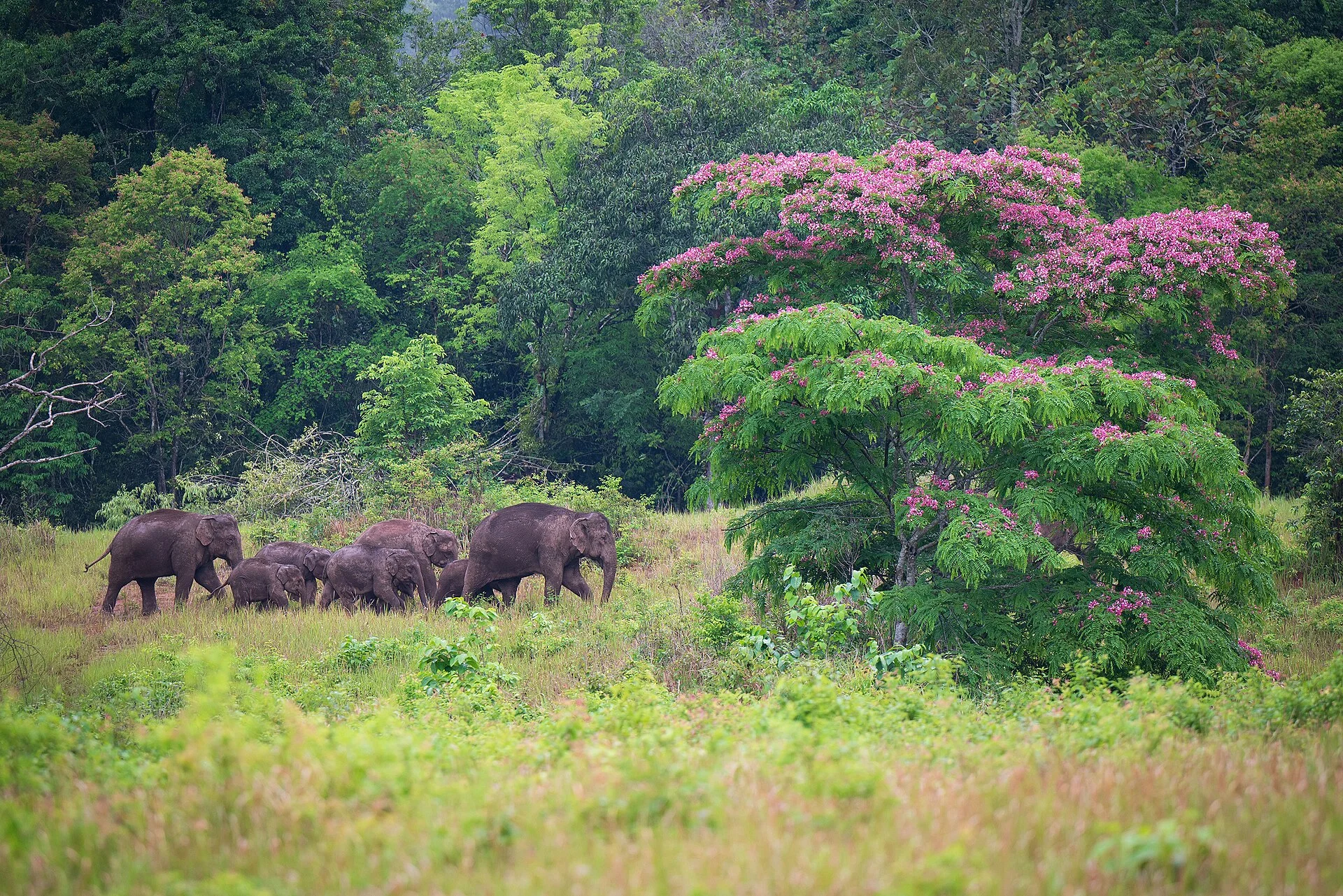

Khao Yai sits on the edge of Thailand’s north-eastern plateau, about three hours from Bangkok. It’s the name of both a vast national park and the countryside around it, a region of forest, farms, vineyards and design-led retreats. This guide covers the essentials: where things are, how to get there, when to come, how to get around, and how to plan your days.
Khao Yai in brief
| The park | Khao Yai National Park, established in 1962 as Thailand’s first national park, covering about 2,166 km² of forest and grassland |
|---|---|
| World Heritage | Part of the Dong Phayayen–Khao Yai Forest Complex, inscribed by UNESCO in 2005 |
| Gateway town | Pak Chong, Nakhon Ratchasima province, the base for most hotels, restaurants and transport |
| Park gates | Open 06:00–18:00 daily |
| Best for | Wildlife, waterfalls, cool-season weekends, food, and private villa stays |
Understanding the geography
Think of Khao Yai as two places. The national park is wild: winding roads through evergreen forest, grasslands with observation towers, and waterfalls. Wild elephants, gibbons and hornbills live here. The Pak Chong countryside outside the park is where people stay and eat, with resorts, villas, cafes, farms and wineries spread across several subdistricts:
- Mu Si and Thanarat Road (Route 2090) lead up to the park’s northern gate and form the busiest strip of resorts and restaurants.
- Pong Talong, south-east of Pak Chong town, is quieter countryside with larger resorts.
- Wang Kata and Wang Sai offer hill views and golf-course settings.
- Pak Chong town is the transport hub, with the railway station, markets and everyday services.
Getting there
- By car: roughly three hours from central Bangkok via Highway 1 and Highway 2 (Mittraphap Road), depending on traffic.
- By train: long-distance trains run from Krung Thep Aphiwat Central Terminal to Pak Chong. The fastest take around 2 hours 40 minutes, and slower services nearer 4 hours.
- By private transfer: many resorts can arrange pickups from Bangkok or the airports.
Full details are in how to travel from Bangkok to Khao Yai.
When to go
- Cool season (November–February): dry days and cool evenings. This is peak season.
- Hot season (March–April): warm and quieter, and a good time to enjoy a private pool.
- Green season (May–October): lush forest and full waterfalls. Expect rain and leeches on trails, and possible seasonal closures.
Read the best time to visit Khao Yai for a month-by-month view.
Getting around
A car or private driver is the easiest option, because attractions can be 20 km or more apart. There are no petrol stations inside the park. Fill up in Pak Chong or along Thanarat Road. Inside the park, drive slowly. The limit is 60 km/h, and elephants have right of way.
Park fees and rules
Entry is charged per person per day, with a higher rate for foreign visitors, plus a vehicle fee. Check current rates on the official park fee page. Swimming at the main waterfalls is not allowed, feeding wildlife is prohibited, and large or tall vehicles are restricted.
Where to stay
For a pool of your own, start with our guide to luxury pool villas in Khao Yai. If you prefer a full-service hotel, compare luxury resorts near Khao Yai National Park. Our luxury accommodation guide explains each area in detail.
What to do and where to eat
- Top attractions in Khao Yai: waterfalls, viewpoints, wildlife, art and wine
- Restaurants in Khao Yai: Michelin-recognised Thai kitchens to dinner in a railway carriage
- A three-day luxury itinerary